Google’s 10-Page SERP Limit Is Here: What It Means for AI, SEO & Your Growth (and How Humbear Media Is Already Ahead)
Google’s 10-Page SERP Limit Is Here: What It Means for AI, SEO & Your Growth (and How Humbear Media Is Already Ahead)
TL;DR
Google quietly removed the “view 100 results per page” option and effectively limits public results to ~10 pages. The updated algorithm hides long-tail content from users while it creates less competition through fewer search results and changes how web content appears to AI agents and scrapers and SEO tools. Brands that achieve success will be those which create superior content while using intent and entity optimization and artificial intelligence to directly capture and convert customer demand.
Humbear Media anticipated this shift. We’ve rolled out a new platform layout, faster automations & workflows, and smarter AI Chat & Voice Bots that:
Capture more conversations on-site and via SMS,
Route and qualify leads automatically,
Learn from every interaction to improve conversion.
This article explains the modifications which occurred and their significance for AI and SEO and describes our approach to handling this change for our client base.
What Changed?
For years, advanced users and SEOs could switch Google to show 100 results per page. The system introduced new capabilities which allowed users to perform competitive research and long-tail discovery and technical SEO auditing at a faster pace. Google has now removed that option and essentially caps public pagination to ~10 pages (the exact count can vary, but the effect is the same: far fewer immediately viewable results).
Practical implications:
Less surface area for organic discovery. If you relied on being result #83, that visibility is gone.
Tighter competition on page 1–3. Click-through becomes even more winner-take-most.
AI agents and scrapers that used to extract big data from page 1 through 10 and beyond will now encounter reduced data availability because of limited access to authenticated APIs.
The methods used by SEO tools that mimic deep pagination need to change because historical comparison data becomes less reliable.
Why Did Google Do This?
We can’t speak for Google, but several forces likely converged:
Users tend to pick results from the first few pages because pagination simplification makes the interface easier to use and reduces system response time.
The practice of limiting freely paginated results serves two purposes: it decreases the amount of bot traffic and simultaneously lowers infrastructure costs.
AI answers should be the main priority because AI Overviews/SGE and enhanced result types enable Google to present users with more reliable information.
Quality signals > quantity: The scarcity of visible results makes E-E-A-T and entities and brand authority more valuable.
The 10-page limit generates particular effects on AI systems.
1) Narrower Training Windows for Naïve Agents
The learning process of unsupervised agents which extract data from SERPs results in limited knowledge acquisition. The lack of authenticated knowledge sources makes it possible for them to overlook specialized pages which used to exist on results pages deeper than 5–10. The outcome will produce competitive maps which lose their detailed features and recommendations that turn into generic standards.
2) Entity-First Becomes Essential
Modern AI systems handle topics by using entities that include organizations and services and locations and people. The reduced number of search engine results page (SERP) slots requires better entity clarity because it depends on correct structured data and consistent NAP information and well-connected content hubs. The process enables AI systems and Google to identify your brand identity which leads to better search engine ranking.
3) Preference for Authoritative Sources
The process of attention compression leads users to select brands that demonstrate authority through review signals and first-party data and case studies and medically reviewed content for health topics and citations. If you’re in behavioral health, these signals are not optional.
4) First-Party Data and Closed-Loop Learning Win
The lack of sufficient SERP data requires growth teams to use first-party conversational data which includes chat logs and call summaries and form inputs and their corresponding outcomes. Humbear Media’s AI Chat & Voice Bots collect large amounts of data which enables them to enhance their next-step prompts and qualification logic and offer matching algorithms.
The changes in search engine algorithms will affect how organizations optimize their websites for search engines (SEO) and produce leads in the behavioral health industry.
The first page of a document matters most but the second page also holds value.
CTR curves get steeper. We double down on intent-matched content designed to truly answer the searcher’s job-to-be-done. The guidance for addiction treatment centers and mental health clinics should present medical information in simple language with specific directions for what to do next.
Topic Clusters > One-Off Posts:
The entity understanding system of Google provides rewards for clusters that include detox and residential and IOP and PHP and MAT and aftercare programs with their respective subtopics about insurance verification and admission timelines and packing lists and family involvement. We develop connected information centers which include FAQs and calculators and downloadable checklists.
Conversion Multipliers on Every Page:
The number of organic at-bats has decreased so each training session becomes crucial. The platform of Humbear Media enables users to stick to conversations through chat functionality and provides widgets for callbacks and SMS follow-up and smart forms that change according to insurance type or location or program suitability. The AI Voice Bots system runs during periods of low customer activity to stop leads from entering an inactive state.
Local & Entity Signals Turn Up:
Google Business Profile updates, service areas
Photos, posts, and “common questions” answered
Yext/directory cleanup and schema markup
Physician, clinician, and program entities marked up with medical/organization schema
The system reveals topical authority through these features by displaying reduced search results.
Content Velocity, But With Precision:
You can’t brute-force page 7 anymore. We concentrate on obtaining information that directly answers the patient's questions (e.g., “Does Tricare cover residential treatment?”). The system generates authoritative responses through its AI assistance which enables conversion into chat voice and SMS formats.
Humbear Media demonstrates its ability to adapt to changes through its approach which delivers advantages to its clients. We built our roadmap around the idea that SERPs would compress and AI would intermediate more queries. The new stack solves these issues through its implementation of these features.
1) The new platform design centers on achieving results as its fundamental purpose.
The system provides users with a clear path to navigate between leads and conversations and pipelines.
The dashboard includes three main KPI tiles which display cost per admit and speed-to-first-touch and AI booking rate.
The system allows users to access complete source/keyword/creative insights with a single click for immediate drill-down functionality.
The outcome generates teams that operate at high speed while minimizing tab-sprawl and decreasing hand-off mistakes.
2) Improved Automations & Workflows
The system directs leads through intent-based routing which depends on insurance types and distance and level of care requirements.
The system employs scoring and suppression methods to block spam and low-quality leads from entering the system.
The system uses a multi-level follow-up system which integrates human interaction with AI voice messages and SMS and email communications that depend on program schedules and call center operating hours.
The system requires particular triggers to confirm insurance coverage before it can initiate a live call with patients.
The outcome included better connect rates and cleaner calendars and more admissions from the same advertising budget.
3) Smarter AI Chat & Voice Bots (HIPAA-friendly)
The system uses on-site chat and Facebook/Google lead-form responders to establish rapport with customers while collecting insurance details and then moving them to the admissions process.
The system operates through voice agents which confirm vital details and set service expectations and book assessment appointments for after-hours calls.
The system generates behavior-aware prompts that adjust their responses according to Tricare/Tri-West and PPO coverage information and detox schedules and travel plans.
The system captures demand during peak front desk hours by using every interaction to improve service delivery.
4) The search strategy was developed for the 10-page world.
The system includes topic hubs which contain entity-rich schema for every stage of care.
The E-E-A-T standards receive additional support through Medical review layers and authorship.
The optimization of FAQ content and snippets functions as a method to achieve better above-the-fold search engine rankings.
Local pack optimization requires the use of image geotags and posts and Q&A sections.
Result: More SERP visibility where it counts—and better conversion once users land.
Your Updated Playbook for 2025+
The following checklist helps your team members adjust to the new work environment:
A. Protect & Expand Page-1 Surface Area
Map primary money pages to commercial intent queries (detox near me, residential rehab PPO, Tricare alcohol treatment).
Add FAQ accordions answering adjacent long-tail (the ones that used to live on page 4–8).
Implement FAQ Page, Organization, Medical Organization, Physician, Product/Service schema where applicable.
B. Build Entity Authority
The website and directories need to display the same brand name and services and addresses and clinician credentials.
The organization needs to release case studies which should be accompanied by clinician articles and program outcome summaries.
The company should create a media/press page which will contain all the mentions and awards received by the company.
C. Capture Demand With AI
The AI Chat system needs to operate on pages which demonstrate strong user intent (Insurance Verification, Admissions, Locations).
The system needs to have AI Voice functionality for managing calls that occur outside business hours and when the system reaches its capacity because these calls will automatically redirect to your EHR/CRM system.
All conversational data needs to enter a closed-loop learning system which monitors the booking prompts and conversion-stopping objections and insurance companies with fast application approval processes.
D. Tighten Measurement
Track speed-to-first-touch, AI-assisted booking rate, insurance match rate, show rate, admit rate, and cost per admit.
The content topics should be connected to the downstream admits instead of being limited to form fills.
Frequently Asked Questions
Q1: My older long-tail posts will they continue to receive traffic?
The algorithm does not require deep pagination visibility but websites will need to use internal links and hub pages and featured snippets instead. We convert various thin posts into comprehensive guides which can help achieve both snippet positions and People-Also-Ask box visibility.
Q2: Does this make PPC/Social Media Lead Gen Mandatory?
Organic still drives qualified demand. But with tighter SERPs, we pair Lead Gen + SEO + PPC + AI conversion. Paid campaigns provide immediate search result visibility at the top positions yet organic content requires time to build authority.
Q3: How does Humbear Media's AI Voice Bots actually improve admits?
They answer immediately, qualify politely, and book assessments. The number of monthly admissions will change when beds are available because a 10–15% improvement in after-hours call responses can make a difference.
Q4: Is this change permanent?
We plan as if it is. Google's future updates will not change the fundamental direction of search results which will show fewer visible results and more answers generated by artificial intelligence. The hedge consists of authority content which combines with first-party lead capture functionality.
Example: From Click to Admit in the New SERP Reality
The user performs a search for information about Tricare coverage of residential alcohol treatment programs.
The guide achieves a featured snippet or top-3 organic listing position when it includes content that has medical review and entity-rich information.
The AI Chat system on the webpage provides an initial welcome to visitors before performing a fast coverage assessment and obtaining their insurance information through secure means.
The system directs Tricare patients to their correct admissions representative while AI Voice takes over to manage additional patient volume.
The session links to a prearranged assessment and admission process which allows feedback to improve content and bot functionality.
The closed loop system of Humbear Media functions in a search environment which provides limited opportunities for SERP slot placement.
What We’ve Launched at Humbear Media (Right Now)
The new design enables users to navigate more quickly while presenting their most important content in an organized manner.
The system requires sophisticated automation features to handle qualification procedures and routing operations as well as subsequent follow-up tasks.
AI chat and voice bots now understand treatment center requirements through their ability to process insurance details and transportation information and treatment length data.
The SERP-compression SEO program concentrates on three main areas which include entity clarity and topical hubs and conversion design.
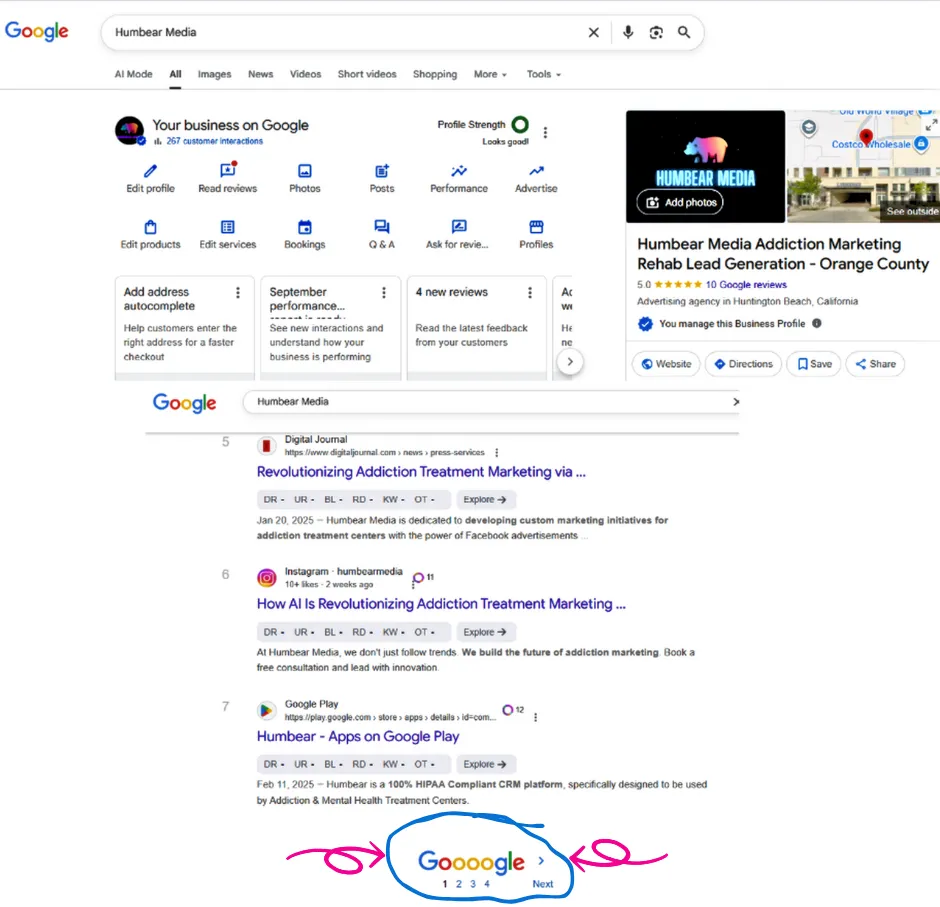
If you haven’t seen the change yet, Google removed the “view 100 results” option and now shows ~10 pages. The platform announcement includes an example image which demonstrates the distinction to your team.
How to Work With Humbear Media on This
Phase 1: Diagnostic & Alignment (Week 1)
KPI baseline: admits, CPA, speed-to-first-touch
Content/entity audit & GBP review
Bot call/chat transcript sampling
Phase 2: Foundation (Weeks 2–4)
Launch on-site AI Chat + after-hours AI Voice
Implement routing & suppression rules; insurance triggers
Create 2–3 entity-rich hub pages which need to be accompanied by their respective FAQs for future publication.
Phase 3: Scale (Weeks 5–10)
Add topic clusters for each level of care
The platform needs to enhance its local content through additional photo and post and Q&A section and location page features.
The website needs optimization for better conversion rates through improved form functionality and sticky chat features and callback requests and clear CTAs.
Phase 4: Continuous Optimization (Monthly)
The system operates at a speed which enables the entry of driving-related content.
Bot prompt A/B and cadence testing
Quarterly schema/entity refresh
The Bottom Line
Google’s 10-page limit concentrates attention on fewer, better results and accelerates the shift to AI-mediated answers. The headwind operates as a selection tool which benefits teams who have prepared well because it tests their ability to deliver powerful messages and build successful conversion designs.
Humbear Media is Already Operating On That Future:
A new platform experience that speeds up action.
Automations that protect your team’s time and raise connect rates.
AI Chat & Voice Bots function as automated systems which produce sales opportunities based on customer needs through their continuous 24/7 operation.
The program focuses on optimizing search engine results for entities and snippets and actual admissions.
Our team stands prepared to help your brand achieve selection as the preferred choice between AI and human operators in the current condensed search engine results page (SERP) environment.
